Kanban Pizza Game
With the Kanban Pizza Game from agile42, you can find out what Kanban feels like
It’s difficult to teach the principles of Lean and Agile simply by lecturing. People have to experience the principles by themselves to get a feeling for how it all works. By playing a game, you can gain experience without messing up your daily work or getting engrossed in the technical details. This is why we use games and simulations extensively in our trainings. If we can find no suitable game we’ll create one… like the Kanban Pizza Game!
While other Kanban games are usually focusing only on the mechanics of the Kanban board and on the flow in a pre-defined Kanban system, our Kanban Pizza Game teaches you how to get from an existing process to a Kanban system, how to visualize it and start modifying it.
Need to brush up on your Kanban knowledge? Register for our online Kanban certification – it only takes a few hours to complete and comes with a certification.
Based on Paper and Pizza
Like our agile42 Scrum Lego City Game, we wanted our Kanban game to be based on something that everybody knows about and everybody can do. We tried to stay away from IT scenarios so that the participants wouldn’t think too much about the similarity to their current work environment. We think that the idea of using paper pizza is great — everybody loves pizza, and everyone knows how a pizza is made (at least in general terms).
When and how to use the Kanban Pizza Game
If you want to understand what Kanban is and practice some Lean concepts in a safe environment outside of your daily work, then the Kanban Pizza Game is for you! We start our Kanban trainings with this game, in order to introduce the whole method and its principles and practices in one tight package. Software development teams and process development teams use this game to get acquainted with Kanban.
The game has been designed for a half-day workshop. It takes at least one hour at the bare minimum, if you rush through the principles and practices and don’t wrap up much at the end. Two hours is enough to cover the theory adequately and allow for reflecting and summarizing.
Learning Objectives
What are the goals of the game from a training perspective? We want participants to:
- Experience how a Kanban system emerges from an existing process, as it does in the real world
- Experience a whole Kanban system, as opposed to focusing only on the Kanban board and related mechanics
- Understand that boards are context-dependent: for any given process there are many different board designs that are adequate and useful, but the perfect board doesn’t necessarily exist
- Understand the effects of limiting your Work in Progress
- Experience self-organization and adaptation
- Have fun!
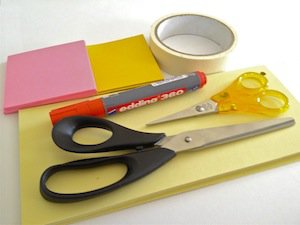
Each team gets paper of different colors, scissors and other materials (the full list of materials is at the bottom of this page). They will cut, shape and tape these together to form pizza slices according to the given recipe.
Materials you will need
- Post-Its in three colors: yellow (pineapple), pink (ham) and green (rucola i.e. rocket salad)
- Printer paper to cut pizza bottoms from (A4/Letter works fine but you can also use other sizes)
- Red markers as tomato sauce
- Glue or transparent tape (to make the Post-Its stick better)
- Masking tape (aka. painter’s tape)
- Scissors (one small + one large per team)
- Stopwatch
- Order cards – one set per team
- Oven plate – one per team
- The Kanban Pizza Game slides
- Rule Sheets
- Kanban Overview Sheets
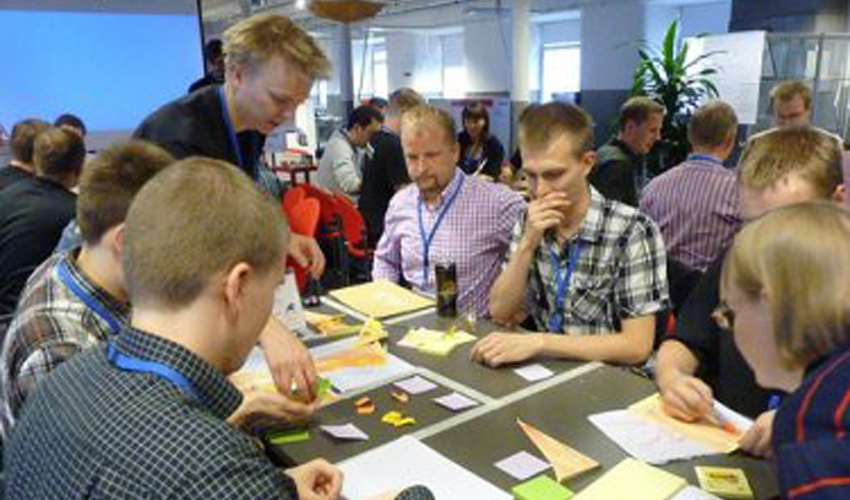
Kanban Pizza Game teams
- Divide into teams of at least four people
- The game can be played with one team, but is more fun with more teams and a little healthy competition
- If there’s an uneven number of people, consider asking somebody to act as an observer, perform quality assurance and measure lead time
The Flow of the Game
1. Create an implicit process
Kanban always starts where you are, from an existing process. At the start of the game, we let the teams get to grips with the paper pieces and constraints by building as many pizza slices (Hawaiian) as possible.
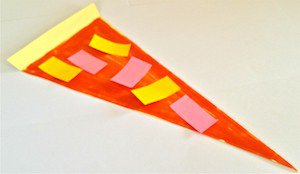 Present a ready-made slice of Hawaiian pizza to the teams and explain what goes into the pizza: a slice of pizza base (paper triangle), tomato sauce (red marker), three slices of ham (pink Post-Its) and three slices of pineapple (yellow Post-Its). The tomato sauce covers the pizza bottom nicely and the toppings are carefully cut and distributed evenly across the pizza. Yum!
Show the oven plate and explain how it works. There can be a maximum of three pizza slices in the oven at one time. Cooking time is at least 30 seconds. No adding or removing of slices while baking!
Then ask the teams to produce as many pizzas as they can while trying to avoid waste i.e. raw materials prepared but not used. When you decide that time’s up (after 5-7 minutes or so) clap your hands and tell them to stop.
2. Introduce Kanban
At the end of the initial round, introduce Kanban and the core practices of Kanban:
- Visualize the Workflow
- Limit your Work in Progress (WIP)
- Manage the Flow
- Implement Feedback Loops
- Make Process Policies Explicit
- Improve Collaboratively
These principles are going to be used throughout the game.
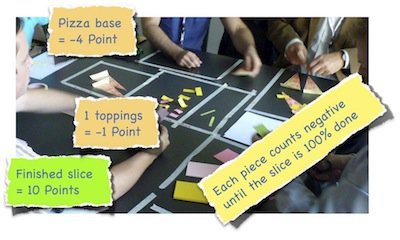
Next, explain the scoring system and let each team calculate their score. The scoring system is designed to promote limiting the WIP and also serves as an indirect measure of flow (in our case, it correlates with the lead time as long as people don’t know the exact length of the round, and thereby produces the same behavior). Collect the scores and write them down in a matrix (teams vs. rounds) on a whiteboard or flip chart. At this point, you can also ask the teams to pick names for their pizzerias.
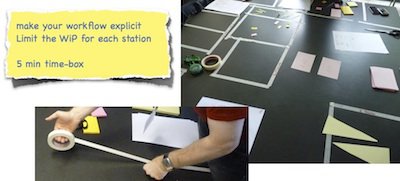
Ask the teams to visualize the workflow and make the process explicit by introducing storage for production materials (pizza bottoms, slices of ham, etc.) directly on the table. Don’t try to optimize the workflow now, just document it as it emerged during the first round. The teams can use the materials at hand, e.g. painter’s tape (masking tape), post-its, paper and so on.
Ask the teams to limit their work in progress. Did they have materials piling up and becoming waste at the end of the round? What would be a sensible WIP limit for that step and for the other steps?
How about pizza quality? Did the teams cut corners (perhaps literally)? Pizza bottoms should be the same size and well covered with tomato sauce, and the toppings should be nicely cut and distributed evenly. Ask each team to bring forward their best pizza(s). Then ask the room to choose the most beautiful specimen. This will become the Reference Pizza and should be put in a prominent and visible place.
Before the next round, ask the teams to throw away the half-baked and delivered pizzas, but keep the unused raw materials for the next round.
3. Second round with established Kanban system
Now run a new one round with your newly established Kanban system. Again, don’t give any indications of when the round will end, just end it when you feel like it’s a good moment in time (after 5-7 minutes). At the end of the round run a debrief and count the points.
4. Third round, extending the system
Make the game a bit more complex by introducing the new Pizza Rucola recipe and the concept of customer orders.
- Pizza Rucola contains only tomato sauce and seven pieces of rocket salad (green Post-Its). There’s no ham and no pineapple. Unfortunately, rocket salad burns easily and must, therefore, be added after the pizza has been taken out from the oven.
- Orders can contain several pizzas of two different kinds, and the team gets points only when the whole order is fulfilled and delivered. Establish a central place where teams can pick up new orders and deliver fulfilled orders. Teams can pull several orders at once, but not so many that it affects other teams.
When you have presented the extensions to the game and answered any questions the teams may have, allow the teams five minutes to discuss and extend their system to account for Pizza Rucola and the orders.
Run the third round. Debrief, measure the points.
5. Fourth and final round
Allow the teams some minutes to discuss and improve their system. Tell them to play around with the workflow and try different WIP limits.
Run the fourth round. Debrief, measure the points.
6. From the game to a real Kanban Board
The final step in the game is to visualize the process that is currently drawn on the tables with painter’s tape, and create something that is closer to a real Kanban board.
Ask the teams to look back on the game, draw the flow on a flipchart or whiteboard (including WIP limits) and make it look nice using paper materials and pizzas produced during the game.
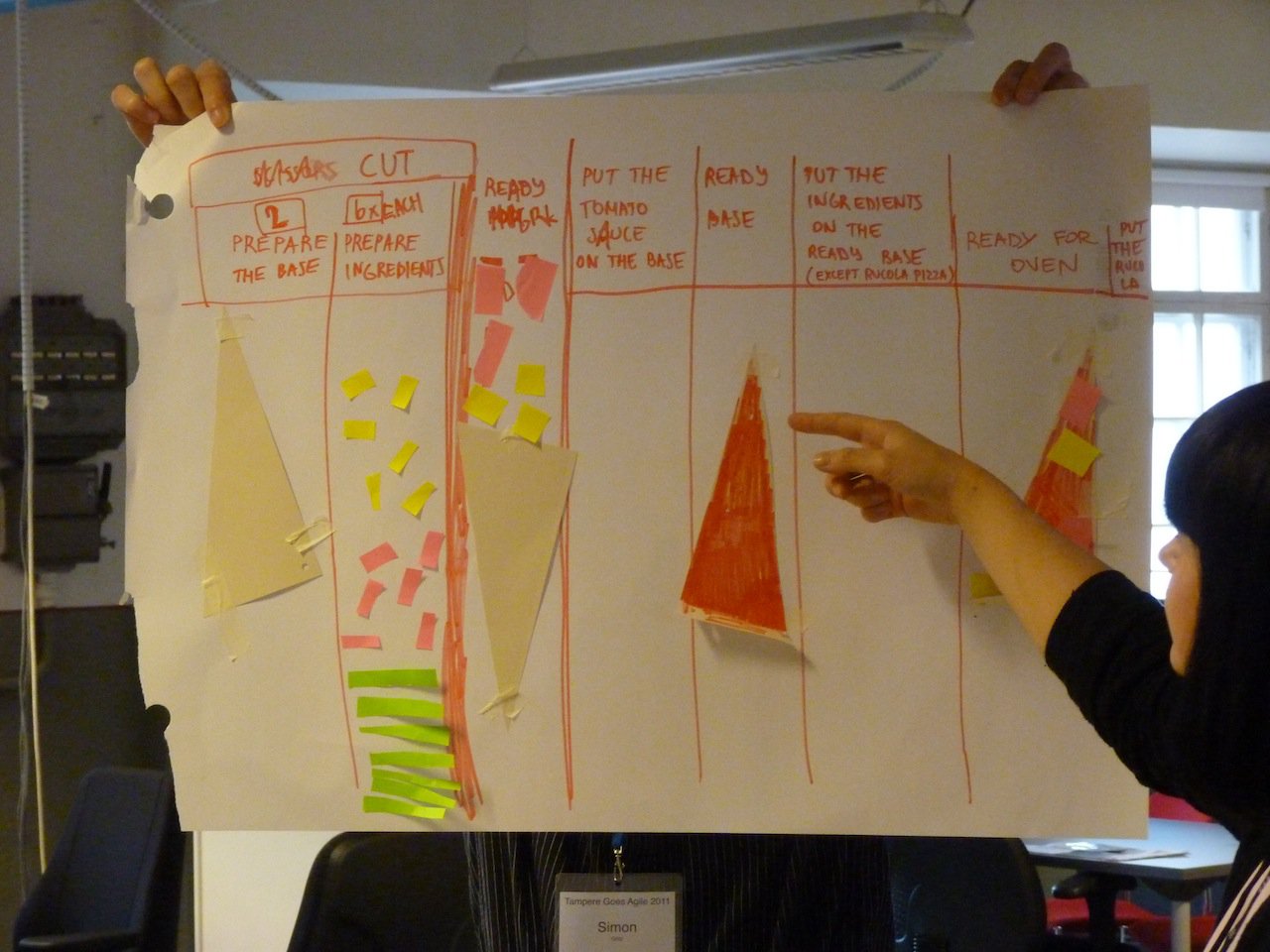
7. Debriefing
Having the experience of the Pizza Game in fresh memory and some nice Kanban boards on display, it’s now really easy to anchor the Kanban practices.
Visualize the workflow
With the physical production of the Pizza, the workflow is always present, and by drawing the workflow we create a model that we can use for reflecting on the current process. Remember: all models are wrong, but some are useful. The workflow is a simplification and can never match reality perfectly, but it allows us to study and understand our work.
Note that the workflow can be represented in multiple ways. The fact that some pizzas go into the oven with toppings and some without can be described using tags, swimlanes, non-linear workflows, directed networks, cadences (alternating between Hawaii and rucola in the oven) or a number of other methods.
Over the course of the game, each team created a workflow that made sense in their own context of people, resources and bottlenecks. While it is likely that other teams could pick up a board and make it their own, it doesn’t mean that anyone of the boards is necessarily “more right” than the others.
Limit WIP
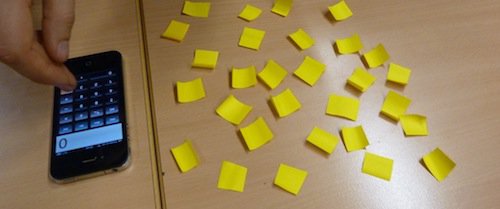
Throughout the game, the built-in bottlenecks caused queues to pile up. This is intentional. During the game, the teams introduced limits on the work in progress (WIP) to make sure that they produce the right things and to avoid losing points for unused materials. The participants experienced that WiP limits are more than simple limitations: they drive and change the behavior of people. People tend to interact more on the overall production, communicate more and help each other when needed.
Manage flow
Kanban works best when work is flowing nicely through the system. Normally you would increase the flow by measuring and minimizing the lead time. Unfortunately, this takes too much time away from the facilitator, and so in the Pizza Game, we use a scoring system that is set up to penalize inventory and trigger similar flow-optimizing behavior.
In the first rounds of the game, there is a tendency to prepare small stockpiles of materials in advance. In later rounds, the team learns to keep inventory down and maintain flow by tightening the WIP limits.
Measuring the flow in the Pizza Game can be very instructive, but you will need a co-facilitator to do this.
Make process policies explicit
After the first round, each team documented their workflow by marking it on the table. Any changes to the system were made immediately on the table. We also set a common quality standard by selecting a Reference Pizza. How did this help the work? How about roles? Did people have clear roles? How did they appear? Who allocated the “resources” in this simulation?
Implement feedback loops
What did we collect feedback on? Ask the teams to think for a moment about what kinds of feedback loops there were in the game, and write these on post-its. You can either collect all post-its on a board or ask people to give examples. During the debrief, ask them what would have happened without each specific type of feedback.
Improve collaboratively and experimentally
The game consisted of four rounds, with time for inspecting and adapting in between. What would have happened without the possibility to inspect and adapt? Who did the inspecting and adapting? What information was it based on? What did people in the tables talk about during pizza production?
Other things worth considering:
- The physical environment: Did the original table arrangement affect the initial workflow? The way the workflow evolved?
- Group dynamics: How did the different team members participate in design of the workflow?
Questions, Answers, Tips and Tricks
Can we take unused raw materials and use them in the next round?
Yes, you are supposed to do exactly that. The unused slices of ham, pineapple, rocket salad and pizza bottoms on the table will of course give you negative points at the end of each round.
Why can’t we have a big stopwatch and rounds of exactly six minutes?
If the team knows how much time is left, they will start ramping down the process ahead of time, in order to minimize waste. While minimizing waste is good, we want the teams to do it while work is still going on. In practice, something between five and seven minutes seems to be fine.
The team asks for an extra oven, should I give it to them?
No. If you magically “fix” a bottleneck for the team by handing them extra resources, they don’t learn to actually identify and cope with bottlenecks by themselves. Instead they learn that they can complain about the bottleneck and have it magically removed. Oops.
Also remember that whenever you remove the worst bottleneck, another bottleneck will pop up (see the Theory of Constraints for an explanation). It takes a bit of time before the system resettles and the new bottleneck emerges. In the four rounds of the game, we don’t really have time for more than one, perhaps two changes of this kind.
The game is too slow, the teams need more pressure to get things done.
All teams are different and lack of visible pressure is not necessarily bad. Let the game emerge and don’t push the teams into a fixed script. Observe what is happening and gently strengthen good behavior and suppress unwanted behavior. That said, if you feel that the teams are not doing their best, try to create a bit more competition between teams. You could also ask the teams to measure and improve the lead time.
Some teams are working too fast and making ugly pizzas. How should I approach that?
Make it visible, make it explicit. Point out the quality difference to all teams and ask them to agree on the quality level. They could for example nominate a joint QA person to examine and accept pizza deliveries, or draft a Definition of Done, or make a Standard Reference Pizza.
This team is ripping pieces of ham by hand and calling it “pizza artisane”, what should I do?
Teams quickly figure out that scissors are a bottleneck, and some proceed to rip toppings by hand. When challenged, they say that it’s handmade pizza ham and thereby more desirable than factory-cut ham.
Tell them that it’s made from normal ham raw materials (i.e. pink post-its) and they might get feedback from angry customers who thought they were get artisanal ham but didn’t. If all else fails, refer to the Reference Pizza and say that you can’t accept ugly pizzas.
I want to introduce more pizza recipes, can I do that?
The keyword here is Kanban, so please consider spending the time on reviewing the Kanban practices instead. The game already contains two simple but slightly different workflows, introduced one at a time, and this is fully sufficient to bring out all the Kanban practices. Adding more recipes doesn’t improve the learning experience; in fact, some teams already struggle with the two overlapping workflows and would not cope well with the complexity of additional pizza recipes.
Can I measure the lead time anyway?
Yes, measuring and plotting the lead time can be very interesting and constructive. If you want to do this, keep a visible timer running throughout the whole game. This is your “wall clock” or “Pizzeria Mean Time (PMT)”. You can pause it between rounds, but don’t reset it! Ask each team to note the PMT time stamps for accepting and delivering orders on their order cards. They will then have to calculate the number of seconds needed for each delivery, and calculate the average either for (a) all delivered orders or for (b) all delivered pizzas. (Hint: it’s best to convert timestamps to seconds first e.g. 2m33s is 153s. Then sum up the numbers, calculate the average, and convert back to minutes and seconds.)
Are there any variations and extensions?
If you develop a great extension that in works well and enhances the game, we’d be delighted to hear about it and possibly also include it in a future version. However, we’ve seen and heard of facilitators introducing things that don’t work particularly well, including:
- new pizza recipes (“now with triple cheese!”)
- the pizza courier (somebody dedicated to taking orders and delivering pizzas)
- the quality-conscious customer (veeeeery picky with the pizzas)
- the FDA inspector (“and why are you ripping the ham by hand? tsk tsk…”)
- a money system for buying ingredients and selling pizzas…
Please remember that the Kanban Pizza Game is first and foremost a learning experience and a teaching tool. Actually it’s not even about (real) pizza, it’s about (real) Kanban. Don’t let the game degenerate into mindless entertainment, a cut-throat competition or total chaos. Keep the game tight and focused on the learning objectives in your intended way.
Read more about the game on our Facebook page!
Would you like to get professional help introducing Kanban and playing the game? We offer in-person and remote Kanban training.
Respect the Creative Common License!
License
 This work is distributed free of charge under a Creative Commons Attribution- NonCommercial-ShareAlike 4.0 International License and it is the intellectual property of agile42 International GmbH. Shortly means you can use it for free, you can’t resell it and you are required to share any further modification with the same license format. Read more.